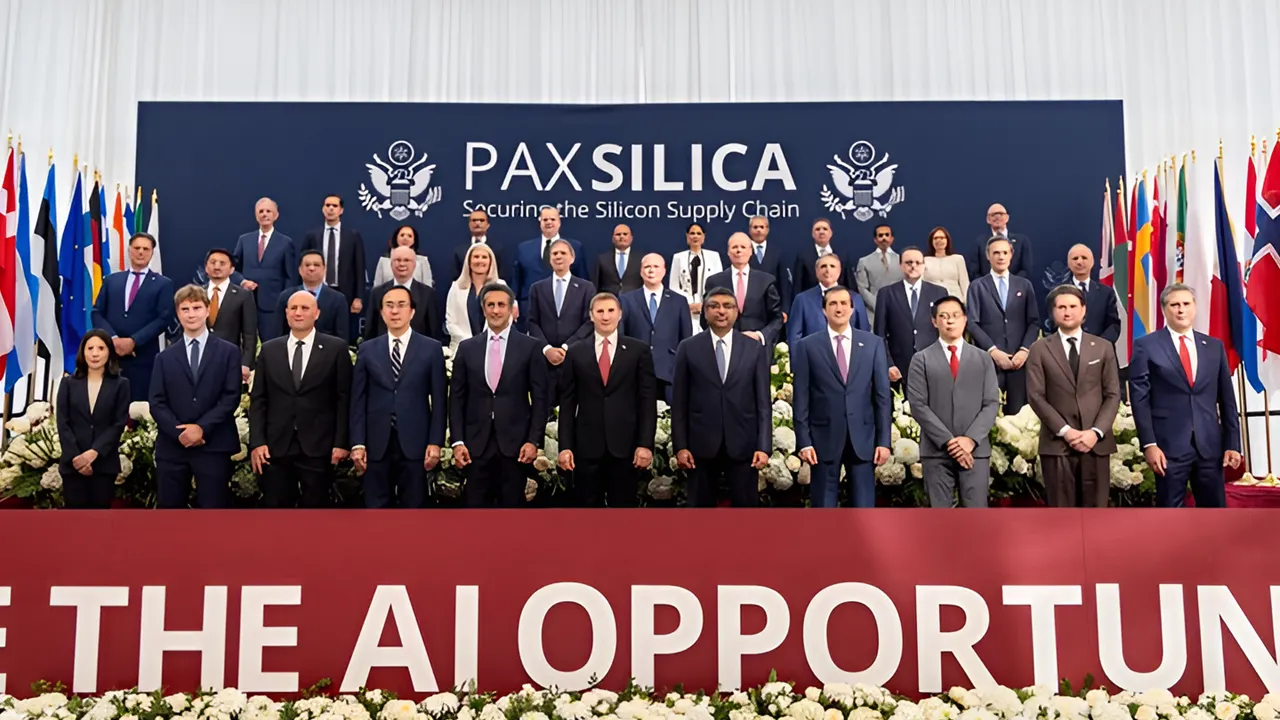
The global race for artificial intelligence supremacy now runs through the Middle East. Bahrain, Qatar, and the United Arab Emirates have all signed a joint statement on AI opportunities at the second Pax Silica Summit in Washington, D.C.. The summit took place on June 25 and 26. The three Gulf nations now stand among 35 signatories committed to building trusted AI supply chains and secure infrastructure.
This is not another policy agreement. Pax Silica focuses on physical infrastructure, minerals, energy, compute power, and semiconductors. The pact aims to secure every layer of the AI economy, from raw materials to finished chips. For the Gulf states, joining early offers a chance to shape the rules before they become permanent.
The UAE sent its most powerful players to Washington. Minister of State Saeed bin Mubarak Al Hajeri led the delegation. Abu Dhabi AI holding company G42, its subsidiary Core42, and AI investor MGX all participated. The Telecommunications and Digital Government Regulatory Authority also joined the team.
Qatar and the UAE joined Pax Silica earlier this year. Bahrain signed the joint statement through its Ambassador to the U.S., Shaikh Abdullah bin Rashid Al Khalifa. However, Bahrain has not yet received formal admission into the alliance.
The joint statement commits signatories to several concrete actions. Countries will pursue pro-innovation AI regulation. They will cooperate on research and development for energy infrastructure and critical minerals. They will work together on trusted semiconductor supply chains. Signatories also agreed to explore joint exports of AI technology stacks, including trusted connectivity, to partner countries. They will expand access to AI compute and next-generation data centres. The statement also commits to facilitating cross-border venture capital flows and R&D partnerships to support AI entrepreneurs across member nations.
The UAE is not just signing documents. The country is actively building the systems that make the pact work. In February 2026, G42 announced an assurance framework designed specifically for Pax Silica’s compliance demands. The system provides continuous, verifiable visibility into the location, control, and authorised use of advanced US-origin AI semiconductors.
Instead of relying on periodic audits, G42 uses cryptographic token-level tracking. The framework builds on G42’s Regulated Technology Environment, which already incorporates US cybersecurity standards including NIST SP 800-53. G42 pitched this system as a replicable blueprint for other Pax Silica partner countries to monitor technology use.
The UAE also proposed an enhanced assurance platform for Pax Silica during the summit. The platform offers verifiable visibility into the location, control, and authorised use of advanced US-origin AI semiconductors. This proposal gives the UAE a seat at the table where the technical standards for AI supply chains are being written.
Abu Dhabi’s AI ambitions extend far beyond policy. MGX, the AI investment firm backed by G42 and Mubadala Investment Company, has secured close to $50 billion in fresh commitments from regional and international investors. The firm plans to expand its investments in AI infrastructure and technology. MGX has already built investments across AI models, semiconductor infrastructure, and data centres.
The UAE and the US are also jointly developing the “Ame AI Park” in Abu Dhabi. The project plans for a total capacity of 5 gigawatts, making it the largest AI infrastructure base outside the United States. The first 500-megawatt phase is expected to begin operations by the end of 2026.
For Qatar, the summit marked another step in its AI strategy. The Minister of State for Foreign Trade Affairs, Dr Ahmed bin Mohammed al-Sayed, signed the Joint Statement on AI Opportunity. The statement serves as an annex to the Pax Silica Declaration that Qatar signed in January.
The UAE held bilateral engagements with the US and other Pax Silica member countries during the summit. These included Qatar, Finland, India, Israel, the European Union, South Korea, Norway, the Philippines, Costa Rica, Singapore, and the UK. These meetings signal the growing network of AI cooperation that now connects the Gulf to major economies across Asia, Europe, and the Americas.
Pax Silica started as a US-led initiative to secure AI supply chains from critical minerals to advanced semiconductors. The pact now includes 35 countries. New members that joined at the summit include Argentina, Germany, the Netherlands, Chile, Costa Rica, Greece, Kazakhstan, Panama, and the European Union.
The initiative focuses on building an economic security consensus among allies. The goal is to advance supply chains that are secure, prosperous, and innovative. For Gulf nations heavily invested in AI, this alignment with US-led standards offers both protection and opportunity.
The Gulf states have moved quickly. Qatar and the UAE joined the pact in January. Bahrain signed the joint statement in June. Their participation in Pax Silica gives them access to US-origin AI semiconductors and technology that might otherwise face export restrictions.
G42 has already secured assurances from the US government to obtain export licenses for advanced AI chips. The company expects to receive its first AI chip shipments within months to support an initial 200MW of capacity for its planned Stargate cluster. Deliveries will mostly include chips from Nvidia, but G42 will also receive shipments from AMD and Cerebras Systems.
This access to advanced hardware gives Gulf AI companies a significant advantage. They can build large-scale AI infrastructure without the supply chain constraints that affect other regions. The assurance framework that G42 developed for Pax Silica provides the transparency that US regulators require.
The joint statement also commits signatories to exploring joint exports of AI technology stacks to partner countries. This provision opens the door for Gulf nations to become exporters of AI infrastructure and services, not just consumers. The UAE, with its massive investments in data centres and compute capacity, stands to benefit significantly.
The Pax Silica framework covers the entire AI supply chain. This includes critical minerals, energy inputs, advanced manufacturing, semiconductors, AI infrastructure, and logistics. For Gulf states rich in energy resources, this alignment creates a natural synergy. They can supply the power that AI data centres require while also building the compute infrastructure that runs on that power.
The US State Department hosted the second Pax Silica Summit in Washington D.C.. US Under Secretary for Economic Affairs Jacob Helberg issued the joint statement on June 25, 2026, ahead of the summit. The statement aligns signatories behind a pro-growth, pro-innovation regulatory approach for the AI era.
The UAE’s participation in the summit followed months of preparation. The country has worked hard to influence the establishment of the new treaty. By joining early and proposing concrete technical solutions, the UAE has positioned itself as a key partner in shaping Pax Silica’s rules around supply chains and trusted AI stacks.
This proactive approach reflects a broader shift in the Gulf’s technology strategy. These nations are no longer waiting for AI to arrive. They are building the infrastructure, securing the supply chains, and writing the rules that will govern the AI economy. Pax Silica provides the framework, and the Gulf states are moving quickly to fill it with substance.
The path ahead involves significant work. Signatories must translate the joint statement into concrete agreements. They must build the physical infrastructure, secure the supply chains, and develop the regulatory frameworks that the pact envisions. But the Gulf states have already shown they can move faster than most. Their early participation in Pax Silica, combined with massive investments in AI infrastructure, positions them as serious players in the global AI economy.
Bahrain’s formal admission to the alliance remains pending. But its signature on the joint statement signals strong interest in joining the pact. Once admitted, Bahrain will join Qatar and the UAE as full members of this exclusive AI club.
The Pax Silica agreement represents a new phase in global AI cooperation. It moves beyond policy principles to address the physical realities of building AI infrastructure. For the Gulf states, participation offers access to technology, influence over standards, and a seat at the table where the future of AI is being decided. They have signed the statement. Now the real work begins.