
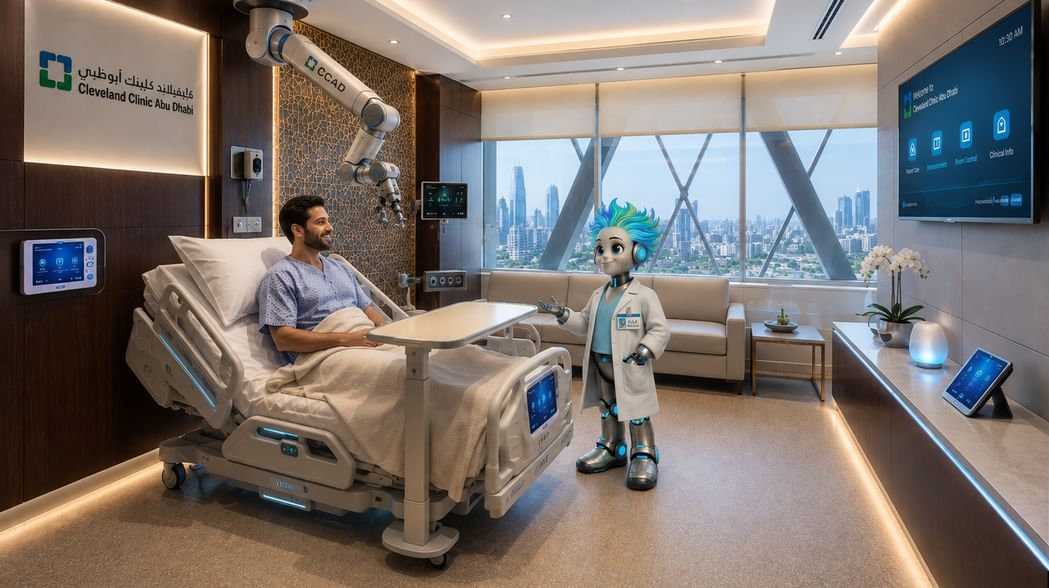
Doctors spend too much time hunting for information. They dig through patient records, scan lab reports, and review imaging results. This process takes days or even weeks. A new AI tool from Cleveland Clinic Abu Dhabi changes that. The hospital launched Aila, the world’s first clinical AI scientist, on June 17, 2026. Aila helps physicians analyse patient data in real time. It turns fragmented information into clear insights. This shift means faster decisions and better care for patients.
What Aila Actually Does
Aila is not a robot that replaces doctors. It is a decision-support platform. Physicians talk to it through a secure natural-language interface. They ask questions about patient data. Aila processes complex datasets and delivers actionable medical insights within minutes. Tasks that once required days or weeks of manual analysis now happen almost instantly. The platform continuously learns from new information. It connects electronic health records, physician notes, pathology reports, and medical imaging into one unified system. This gives clinicians a complete picture of a patient’s health at the point of care.
Starting With Prostate Cancer
The initial deployment of Aila focuses on prostate cancer. This makes sense. Prostate cancer is one of the most common cancers in men. Early detection and precise treatment planning save lives. Aila integrates multiple clinical data sources to support diagnosis and treatment decisions. The platform helps doctors spot patterns that are hard to see with the human eye alone. This creates a cycle where patient care and research constantly learn from each other. The hospital plans to expand Aila to other medical specialities over time.
The Technology Behind Aila
Aila is built on Owkin’s agentic K Pro platform, which is purpose-built for biology. Owkin is an AI biotech company that specialises in medical research. The partnership between Cleveland Clinic Abu Dhabi and Owkin combines clinical expertise with advanced AI capabilities. The UAE’s AI-enabled infrastructure supports the platform. This infrastructure includes the national push for digital health transformation. The UAE Cabinet recently approved a federal framework for the Agentic AI Project implementation. The National Policy for Advancing Digital Healthcare Services and Artificial Intelligence in the Health Sector provides the regulatory backbone. This policy aims to build an integrated national health system underpinned by AI.
Why This Matters For Abu Dhabi
Abu Dhabi is not piloting AI in healthcare. The city is operationalising it across the entire system. Cleveland Clinic Abu Dhabi is part of M42, a global health champion powered by AI, technology, and genomics. M42 operates more than 480 facilities across 27 countries and serves 15 million patients annually. The hospital was named the UAE and Gulf region’s top smart hospital in Newsweek’s 2026 World’s Best Smart Hospitals rankings. This launch strengthens that position. The UAE has one of the highest rates of AI adoption for health management globally. A recent Edelman Trust Report found that 59 percent of UAE residents use AI to manage their health. The global average is only 35 percent. This shows that people in the UAE trust AI in healthcare. They expect AI to be part of their care.
The Business Impact
Hospitals face pressure to deliver better outcomes with limited resources. AI tools like Aila improve efficiency without compromising quality. Doctors spend less time on data analysis and more time with patients. Faster diagnosis leads to earlier treatment. Earlier treatment improves outcomes and reduces long-term costs. The platform also accelerates medical research. Researchers can analyse patient data more quickly. This speeds up the discovery of new treatments. For Cleveland Clinic Abu Dhabi, this is a competitive advantage. The hospital attracts patients from around the region who want access to the latest technology. It also attracts top medical talent who want to work with advanced tools.
Dr Georges-Pascal Haber, Chief Executive Officer of Cleveland Clinic Abu Dhabi, said the collaboration reflects a commitment to innovation and a responsibility to actively create the future of healthcare. He added that harnessing advanced AI built on real patient data empowers caregivers with tools that enhance clinical judgment, advance discovery, and improve outcomes. This is not just about technology. It is about delivering measurable impact for patients and communities.
What Comes Next
Aila is designed to scale across additional medical specialities. Future versions will incorporate advanced data types such as multi-omics and genomic data. This will support large-scale precision medicine initiatives. Precision medicine tailors treatment to a patient’s genetic makeup. This approach is more effective than one-size-fits-all treatments. The platform will also help hospitals track and improve their performance over time. Cleveland Clinic Abu Dhabi is already exploring other AI applications. The hospital signed an agreement to pilot Polyphonic, an innovative digital ecosystem designed to enhance surgical performance. It also launched an AI-based colorectal cancer screening program in early 2024. Within months, the program screened over 2000 patients. These initiatives show that the hospital is serious about AI. Aila is the next step in that journey.
A Broader Shift In Healthcare
The launch of Aila reflects a broader trend. Healthcare systems around the world are investing in AI. But the UAE is moving faster than most. The UAE National Artificial Intelligence Strategy 2031 identifies healthcare as a priority sector for AI deployment. The strategy aims to generate AED 335 billion in economic growth through AI. This is not just about money. It is about building a more resilient healthcare system. The COVID-19 pandemic exposed weaknesses in healthcare systems globally. AI can help address those weaknesses. It can improve diagnostics, accelerate research, and enhance operational efficiency. The UAE is positioning itself as a global leader in this space.
The Human Element
Technology alone does not save lives. People do. Aila is a tool that enhances clinical judgment. It does not replace the doctor. It gives doctors more information and more time. This allows them to make better decisions. The platform is designed with human oversight in mind. Physicians remain in control. They validate the insights that Aila provides. This balance between human expertise and AI capability is critical. Patients trust their doctors. They also trust AI, as the Edelman report shows. Combining the two creates a powerful model of care.
Final Thoughts
Cleveland Clinic Abu Dhabi has taken a bold step. Aila is the world’s first clinical AI scientist. It changes how doctors interact with data. It accelerates research. It improves patient outcomes. The hospital is not waiting for the future. It is building it. The UAE’s AI-enabled infrastructure and national strategy provide the foundation. The partnership with Owkin provides the technology. The clinical expertise of the Cleveland Clinic Abu Dhabi provides the execution. This is a model for other healthcare systems to follow. AI in healthcare is not coming. It is already here. And it is making a difference.