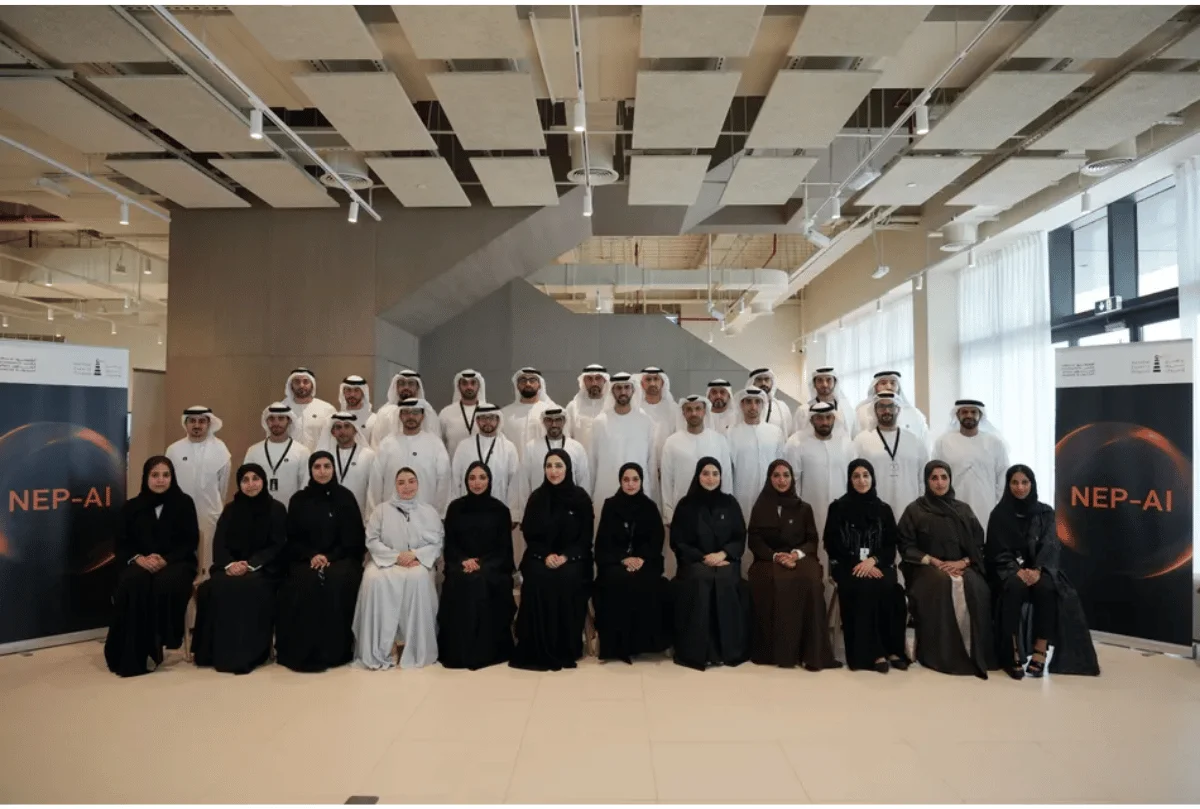
The United Arab Emirates has begun the first technical training phase of its National Experts Programme AI Track, known as NEP-AI, marking a new stage in the country’s push to build homegrown artificial intelligence talent. The session opened in Abu Dhabi on July 21, 2026, with Omar bin Sultan Al Olama, Minister of State for Artificial Intelligence, Digital Economy, and Remote Work Applications, and Omran Sharaf, Assistant Foreign Minister for Advanced Science and Technology, both in attendance.
A foundation module for 32 Emirati experts
Thirty-two Emirati professionals are taking part in the opening module, titled AI Foundations and the AI Stack. The curriculum introduces participants to the technologies, infrastructure, and data systems that support modern artificial intelligence tools. Organisers describe the module as the technical groundwork for the rest of the programme, which will later move into leadership, strategy, and innovation content once participants have a shared understanding of how AI systems are built and operated.
Each participant will apply what they learn to a capstone project addressing a real organisational or national challenge. The intention is to turn technical instruction into practical AI solutions that carry measurable impact, rather than leaving the training as a purely academic exercise.
Part of a broader national AI strategy
NEP-AI was launched in November 2025 by Sheikh Mansour bin Zayed Al Nahyan, Vice President, Deputy Prime Minister, and Chairman of the Presidential Court. It exists as a specialised track under the wider National Experts Programme and is designed to support the objectives of the UAE National AI Strategy 2031. The full programme runs from June 2026 to January 2027 and is structured across seven modules covering technical skills, governance, policy, and leadership.
Participants are drawn from 25 priority sectors, reflecting an aim to spread AI capability across government and industry rather than concentrate it in a single field. The programme combines academic instruction, mentorship, and international study visits, with an in-person commitment of roughly one week each month. According to programme organisers, candidates were selected through a competitive process involving interviews with subject matter experts, programme fellows, and alumni, with assessments showing strong familiarity with the National AI Strategy 2031 among applicants.
Building execution capacity, not just infrastructure
Programme leadership has described the initiative as a shift in focus from AI infrastructure investment toward building the local capacity needed to put that infrastructure to use. Having already established significant computing and data capabilities, the UAE is now directing attention to developing professionals who can translate national AI ambitions into institutional outcomes across sectors such as health, education, sustainability, and mobility.
The curriculum for later modules is expected to cover AI governance, cybersecurity, data monetisation, and the broader economic and societal implications of deploying AI at scale, alongside the technical material introduced in the opening session.
For Gulf economies competing to position themselves as global AI hubs, talent development programmes like NEP-AI represent an attempt to close the gap between ambitious national strategies and the practical expertise needed to execute them. The first cohort’s progress through the coming modules will offer an early signal of how effectively that gap can be closed.