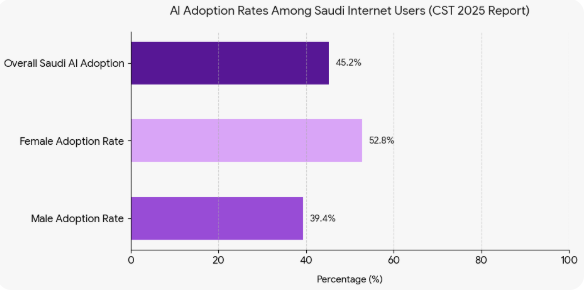
Nearly half of all internet users in Saudi Arabia now use artificial intelligence tools. That is 45.2 percent of the country’s online population. This is mainstream adoption at a scale that few nations have achieved. The data comes from the Saudi Internet Report 2025, published by the Communications, Space and Technology Commission (CST).
For context, the global average for generative AI usage sits at around 16.3 percent. Saudi Arabia is running nearly three times ahead of that curve. The country also records average mobile data consumption of 53 GB per month. That is three times the global average. And with a median mobile download speed of 216 Mbps, Saudi Arabia ranks among the top five G20 nations for internet performance.
These are not accidental figures. They reflect a deliberate national strategy that has been in motion for years. The question is not whether Saudis are using AI. The question is what this tells us about where the country is heading.
Women Lead AI Adoption While Men Trail Behind
The gender data in the report stands out immediately. AI adoption among Saudi women sits at 52.8 percent. Among men, it is 39.4 percent. It runs counter to the global pattern where men typically outpace women in tech adoption.
The reasons are rooted in policy. The Saudi Data and Artificial Intelligence Authority (SDAIA) runs the SAMAI initiative, a national program designed to train one million citizens in AI and data skills. The program has already surpassed that target. Women make up 52 percent of the participants. This is not a coincidence.
The government has made female participation a priority. The digital sector workforce now includes 35 percent women, a sharp rise from just 7 percent in 2018. Saudi Arabia ranks first globally for women’s empowerment in AI, according to the Stanford AI Index 2025. The adoption numbers simply confirm that these policies are working.
Young Saudis are driving this shift even more aggressively. Among users aged 10 to 19, adoption hits 58.4 percent. For those aged 20 to 29, it sits at 55.7 percent. The numbers drop steadily with age. Only 14.8 percent of users over 60 use AI tools.
This age gap presents a clear challenge. Older Saudis are being left behind in the digital transition. The government will need to focus AI literacy campaigns on this demographic. The data gives policymakers a roadmap. They know exactly where to direct their efforts.
Saudis Use AI for Information, Not Just Work
The report reveals what Saudis actually do with AI tools. Information search dominates at 80.8 percent. Idea generation follows at 40.1 percent. Study and education come in at 37.7 percent. Image, video, and presentation creation accounts for 25.7 percent.
Work-related tasks rank lower at 17.3 percent. Writing tasks sit at 14.3 percent. Programming and technical tasks register at just 13.5 percent.
Saudis are using AI as a personal productivity tool first. They treat it like a smarter search engine or a study assistant. They are not yet using it extensively for professional work. That will change as more businesses integrate AI into their operations.
Enterprise adoption is already accelerating. A recent SAP survey found that 81 percent of Saudi enterprises are deploying AI solutions tailored to their industries. More than half of these companies expect significant returns from AI investments within one to two years. The business sector is moving fast. Consumer adoption is following close behind.
The Infrastructure Backs Up the Ambition
None of this happens without serious investment. Saudi Arabia announced over $14.9 billion in AI and emerging technology investments at LEAP 2025 alone. The Kingdom is targeting 2.2 GW of IT load capacity through hyperscale data centres.
Global tech giants are committing real money. Microsoft invested over $2 billion to build an AI-powered data center. Groq and Aramco Digital committed $1.5 billion for AI-powered cloud computing. Alat and Lenovo pledged $2 billion for an advanced AI and robotics manufacturing centre. Google launched a global AI hub in the Kingdom.
The Public Investment Fund launched HUMAIN in May 2025 to build the entire AI stack from data centres to applications. HUMAIN has already led a $900 million funding round for Luma AI with a commitment to move data infrastructure to the Kingdom.
These are the physical infrastructure required to support a population that is rapidly adopting AI. The internet speeds and data consumption figures in the CST report confirm that the network can handle the load.
The Gap Between Consumer and Enterprise Will Close
Right now, Saudi consumers are ahead of Saudi businesses in AI adoption. That will not last. The enterprise sector is catching up quickly. The SAP survey shows that 96 percent of companies plan to invest in data quality programs over the next year. They know that good AI requires good data.
The government is also training the workforce. Beyond the SAMAI initiative, SDAIA has launched advanced programs on AI Agentic technologies. The Ministry of Communications and Information Technology has announced large-scale initiatives with global tech companies focused on training and upskilling.
Saudi Arabia wants to be a producer of AI innovation, not just a consumer. The adoption numbers show that the population is ready. The infrastructure shows that the country is capable. The investments show that the commitment is real.
Saudi Arabia is Setting a Benchmark for the Middle East
The UAE reports even higher adoption at 64 percent, but Saudi’s scale is unmatched. The Kingdom has the largest digital economy in the MENA region at $132 billion. It captures more than 40 percent of regional venture capital.
The Saudi model is replicable. Invest in infrastructure, train the population, create regulatory frameworks that encourage adoption. SDAIA has already issued comprehensive AI regulatory frameworks and ethical guidelines. The Personal Data Protection Law regulates how personal data is processed and shared. These measures build trust, and trust drives adoption.
The 45.2 percent adoption figure is not the finish line. It is a checkpoint. The trajectory suggests that number will climb. The infrastructure is in place. The workforce is being trained. The policies are aligned. Saudi Arabia is not just adopting AI. It is building an AI-native society.