
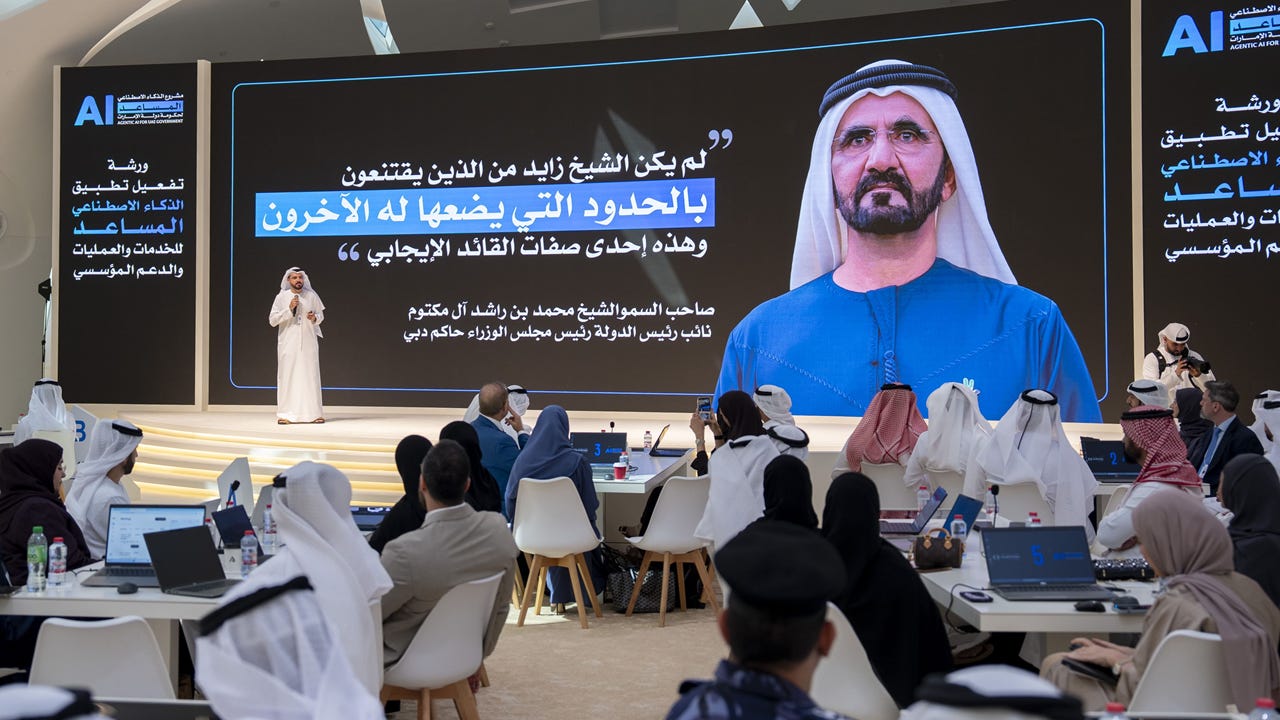
The UAE has moved its agentic AI push out of strategy decks and into day-to-day government work. In April 2026, the UAE Cabinet approved a plan to shift 50 percent of government sectors, services, and operations to agentic AI within two years. In May, leaders approved the first phase of services, launched a training program for 80,000 federal employees, and introduced the first set of AI agents in procurement, tax auditing, customer service, and technical support. Now the government has pushed the next step into a 90-day sprint across 50 federal entities.
Many countries and companies talk about AI in broad terms. The UAE has named owners, set a two-year deadline, approved governance, linked employee training to delivery, and told each entity to choose one service or operation and start building now. That makes this less about AI branding and more about execution discipline.
The plan has moved past talk
More than 300 officials from 50 federal entities joined a workshop run by the Ministry of Cabinet Affairs, and each entity now has 90 days to select, design, and begin implementing a specific agentic AI service or operation. The work spans three phases that focus on selection, service design, and implementation planning.
The UAE had already set the national direction in April, when the Cabinet announced a framework to deploy agentic AI across half of the government sectors and services within two years. The Cabinet also formed a task force overseen by Sheikh Mansour bin Zayed and chaired by Minister of Cabinet Affairs Mohammad Abdullah Al Gergawi. In other words, the UAE built the top-down control structure before it asked agencies to move.
In May, the government added the missing middle layer. It approved a federal framework that defines the role of each ministry and entity, named phase one service categories for citizens, residents, businesses, and the public, and launched what officials called the largest training program in UAE government history for 80,000 employees. That sequence shows unusual seriousness. The state is not asking civil servants to use AI on the side. It is trying to redesign how public work gets done.
The business case goes beyond public service
The first business impact will show up in service speed. The Cabinet has already approved service bundles for citizens, residents, businesses, and investors, while the 90-day sprint focuses on operational areas such as procurement, finance, internal audit, digital support, communication, and shared ministry processes. If those systems cut approval time, reduce repeat paperwork, and improve response quality, companies that deal with government will feel the gain fast.
The second business impact lies in the supplier market. A government-wide agentic AI push creates demand for data integration, workflow tools, audit systems, identity layers, model governance, Arabic and English interfaces, cyber controls, and sector-specific automation. That is where a lot of practical value lies in the current AI market. McKinsey says only 39 percent of respondents report any EBIT impact from AI, and most of those say AI contributes less than 5 percent of EBIT. That tells a simple story. Companies still struggle to turn AI excitement into solid economics, which leaves room for vendors that solve real workflow pain.
The third impact is regional. If the UAE can turn government demand into live reference cases, it will give local and regional software firms a stronger platform for export into other regulated sectors such as banking, healthcare, logistics, and utilities. Governments often move slowly, but they also create standards. When public workflows adopt new tools at scale, the private market follows the operating model.
Founders should pay close attention
Founders often chase the visible layer of AI because it looks easier to sell. The UAE story points in another direction. The money and staying power sit in systems that handle approvals, audits, case routing, document checks, procurement rules, service records, and staff support. These products look less exciting in a demo, but they solve real work.
The best founder lesson here is simple. Build for controlled autonomy, not total autonomy. Deloitte says current agents still need human oversight, and it notes that organizations often succeed more often when they work through strategic partnerships. In fact, Deloitte says pilots built through partnerships are twice as likely to reach full deployment as those built internally. Founders that bring audit trails, access controls, workflow logs, bilingual design, and easy human review will look more useful than teams that promise full automation on day one.
Al Gergawi said the Ministry of Cabinet Affairs already runs around 140 agentic AI assistants on its GovAI platform. That suggests demand will grow for orchestration, not just single tools. Founders should think in terms of connected services that can plug into identity systems, secure records, and legacy software without breaking compliance.
The future of AI will look more like this
The next phase of AI will not live only in chat windows. It will be integrated into workflows, call tools, route approvals, check rules, and support people who manage bigger systems. Deloitte describes this as a mixed workforce where humans focus more on oversight, validation, and new opportunities while agents handle defined processes. The UAE has started to build exactly that model by linking training, service redesign, data policy, and executive accountability.
This is also why the UAE sprint deserves close attention outside the Gulf. It does not treat AI as an app rollout. It treats AI as a new operating layer for government. That is a much harder task, but it is also the one that fits where enterprise tech has moved in the past year. Companies and governments no longer need another generic assistant. They need systems that finish work, stay accountable, and fit existing institutions.
The next 90 days will not decide the whole project, but they will reveal the quality of the foundation. If agencies deliver useful services on time, the UAE will have something more valuable. It will have a working public sector playbook for agentic AI. That would give business leaders, founders, and other governments a concrete model to study and copy.