
A Cairo-based AI community is taking one of the region’s most consequential bets on where the next generation of Arab AI talent will come from: secondary school classrooms.
People of Data, co-founded by Magdi Moussa and Youssef Kamal, believes Egypt’s future competitiveness depends on introducing students to AI while they are still in school. Early exposure, they argue, will create a generation of builders capable of turning technology into businesses, products and solutions that address real-world challenges.
That conviction has produced a concrete initiative: The AI School, a programme built in partnership with AI education platform Skillz.ai.
Teaching Students to Build, Not Memorise
The programme was built around the belief that AI should be taught as a practical skillset rather than a memorised subject. Rather than teaching students to master tools that may be obsolete within a few years, it focuses on helping them identify problems, validate ideas, build solutions and understand whether those solutions can become sustainable businesses.
The founders are clear that the emphasis is on durable skills rather than tool proficiency, so that the pace of AI development can quickly render them irrelevant.
The programme is also deliberately local in its orientation. Students are directed to look at problems within their own communities, schools, universities and neighbourhoods — real challenges they live with every day. The founders argue this gives Egyptian and Arab students a competitive edge that imported solutions cannot replicate, pointing to Egypt’s distinct advantage in AI built for Egyptian and Arabic dialects, while noting gaps to close in public services, education, and healthcare.
The Pilot Results
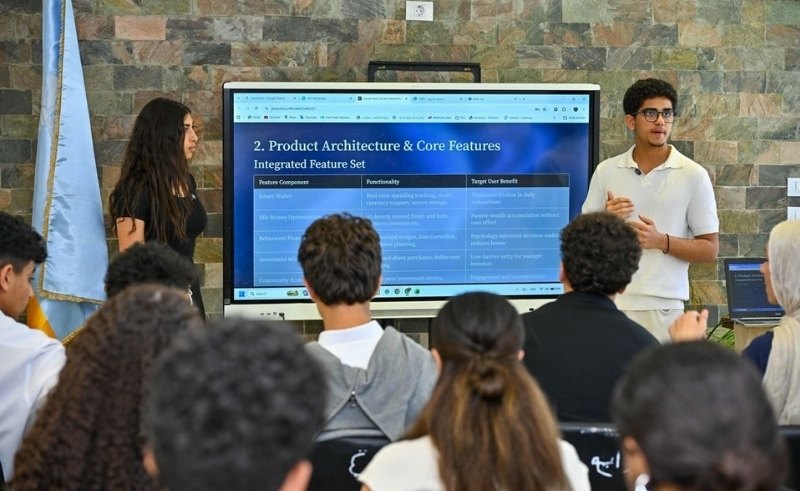
The first major test came through a pilot programme delivered in partnership with Edge Education and Kaumeya Language School. Through the AI for Students upskilling path, 50 students aged between 14 and 21 participated in a three-week programme designed to take them from idea to prototype. Students participated free of charge, with the school covering programme costs.
The outcomes were notable. In just 10 hours of combined instruction and development time, students built 10 viable AI-powered solutions, taking projects from idea to design and development before pitching them to a judging panel led by entrepreneur and investor Ahmed Tarek Khalil. After the judging phase, selected students receive incentives and internship opportunities, while some projects are given the chance to move from prototype to implementation inside schools themselves.
What Comes Next
Following the success of the pilot, The AI School is now preparing to expand across Egypt, partnering with more schools and introducing more tailored programmes for students. The curriculum is designed to evolve alongside the technology itself, refreshing continuously rather than operating as a fixed course.
For a region whose governments are spending billions on AI infrastructure, the harder question has always been who will build on top of it. People of Data’s answer is that they are already sitting in school.