
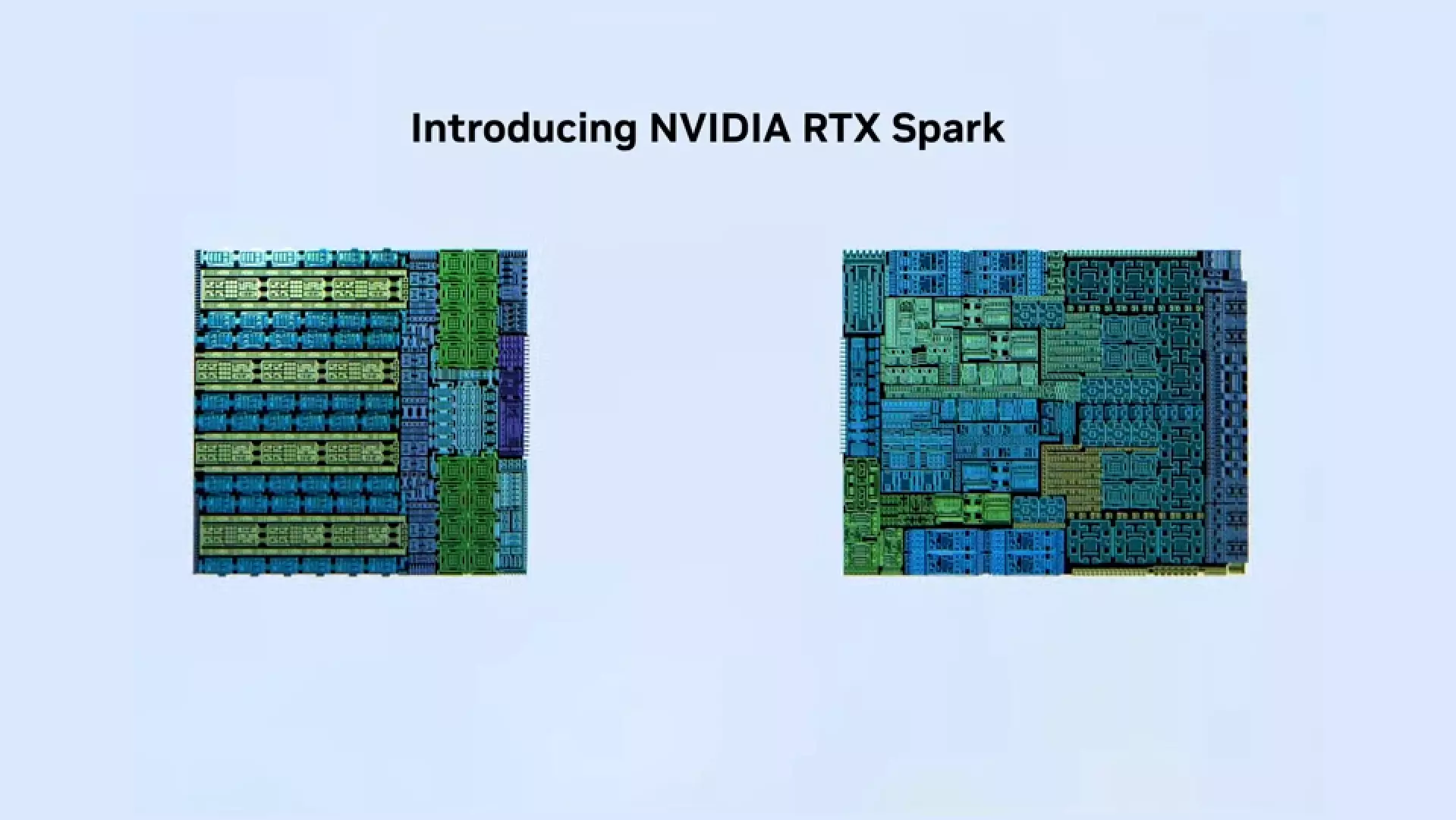
NVIDIA has launched RTX Spark, a chip designed to move artificial intelligence processing off the cloud and directly into personal computers. The announcement was made by CEO Jensen Huang during a keynote in Taipei at the Computex technology conference.
The launch marks a significant shift in how Nvidia sees the personal computer. Rather than simply handling graphics, the RTX Spark chip is built to run AI agents directly on the device.
What RTX Spark Is Built to Do
RTX Spark combines a Blackwell-based GPU with a Grace CPU, delivering up to one petaflop of AI performance and 128GB of unified memory. NVIDIA says this configuration allows the chip to run large language models locally, including systems with up to 120 billion parameters, without relying on cloud infrastructure.
Beyond AI workloads, the chip is also designed to handle demanding creative tasks. NVIDIA says RTX Spark can support 90GB 3D scene rendering, 12K video editing, and AI-assisted design workflows. For gaming, the chip supports high-end titles at 1440p resolution with frame rates above 100 frames per second.
Microsoft and the Push for On-Device AI
The chip is being developed alongside Microsoft, which plans to integrate RTX Spark capabilities into Windows. The two companies are building a version of Windows that enables personal agents while including security features that give users control over what those agents can access and how data is handled.
The emphasis on local processing reflects growing concerns about privacy and latency in cloud-dependent AI systems. By running AI on the device itself, Nvidia and Microsoft are betting that users will prefer keeping their data closer to home.
Creative Tools and Software Partners
Adobe is among the first major software companies adapting its products for the new platform. The company is reworking Photoshop and Premiere to take advantage of RTX Spark’s hardware, with expected improvements in generative editing and video expansion features.
Adobe’s chairman and CEO, Shantanu Narayen, said the partnership would make creative workflows faster and more capable. Other companies preparing support for the platform include Blackmagic Design, Blender, ComfyUI, OTOY, and Xbox.
Hardware Makers Getting Ready
Several major PC manufacturers are building devices around the RTX Spark chip. ASUS, Dell, HP, Lenovo, Microsoft Surface, and MSI are among those confirmed to release products, with Acer and GIGABYTE also expected to follow. The first devices are set to launch in the autumn.
NVIDIA says RTX Spark laptops will feature slim designs, OLED displays, and all-day battery life, targeting both professionals and everyday consumers.
A New Competitive Front for Nvidia
The RTX Spark launch signals a broader strategic move for Nvidia. The company has historically dominated the graphics processing unit market for gaming and data centre workloads. By designing a full PC system around AI performance, Nvidia is now competing more directly with Intel, AMD, and Apple in the personal computing space.
For consumers, the practical implication is that future PCs built on RTX Spark will be able to run sophisticated AI tools locally, without depending on internet connectivity or third-party cloud services. Whether that capability becomes a genuine productivity shift or a premium feature for a niche audience will depend largely on how developers build for the platform in the months ahead.