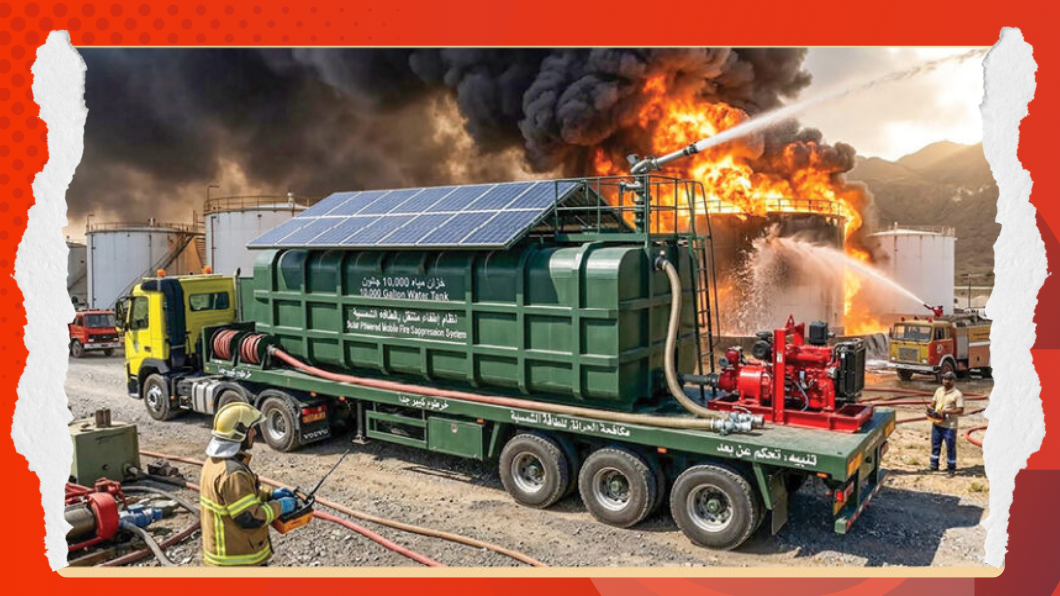
An Omani engineer, Eng Awad Said Al Saadouni, has built a prototype mobile firefighting unit that targets the hardest fires to control, the large industrial ones in oil, petrochemicals, and logistics. He designed it as a trailer that civil defence teams and industrial sites can move fast, operate remotely, and aim with better visibility in smoke.
Industrial fires do not wait for perfect conditions. They spread fast, they involve fuel and chemicals, and they force crews to make decisions under pressure. Oman saw that reality again after reports said drones struck oil storage facilities at Salalah port and authorities worked to contain the resulting fire.
A trailer built for big industrial fires
Al Saadouni built the unit as an advanced firefighting trailer. He aims it at oil installations, petrochemical plants, and large logistics sites where standard equipment can face limits in reach, safety, and sustained flow.
The trailer carries a 10,000-gallon water tank. Al Saadouni compared that with conventional fire engines that often carry about 500 to 1,500 gallons. The extra capacity supports longer operations without constant refills, which matters in large incidents.
That capacity also adds serious weight. He said the water alone can reach about 37 tonnes. So he designed the trailer with reinforced axles and an advanced hydraulic braking system to keep it stable on the road and on site.
How the unit works in plain terms
The unit pairs a high-capacity pump with a remotely controlled fire monitor. Crews can direct water or specialised firefighting agents over long distances and at elevated angles while staying farther back from the heat and smoke.
It also puts cameras and sensors to work where visibility fails. A thermal imaging camera spots hotspots through dense smoke, which helps crews aim streams with more accuracy. The trailer also includes 360-degree surveillance cameras connected via internet protocols for remote monitoring of the scene and movement around the area.
The weather can change a fire in minutes, especially at ports and open industrial yards. So the design includes a weather monitoring system that tracks wind direction, temperature, humidity, and solar radiation. Operators can use that data to adjust approach and positioning during active response.
Power also shapes response. Al Saadouni said the trailer uses solar energy as its primary power source. Solar panels charge batteries that run pumps, monitoring equipment, and remote-control systems. He also said a backup generator can support extra demand.
Safer distance for crews and faster first response
Remote operation changes the risk equation. It reduces the need to place firefighters close to intense heat, toxic smoke, or unstable structures, especially in early minutes when information stays limited. Al Saadouni built the trailer around that goal.
He also positioned it as a first-response tool for remote locations and major facilities. He listed ports, airports, and logistics bases as likely use cases where rapid intervention matters before full civil defence teams arrive.
He added an environmental angle that fits industrial sites near people and water. He said the firefighting materials used in the system come from environmentally friendly natural resources, which he described as safer for sensitive areas and locations near residential or marine environments.
Prototype now and field tests next
Al Saadouni described the project as being in its initial phase. He built the current unit as a prototype to test technical capabilities and refine the design before commercial production. He highlighted testing for remote control, thermal detection, and solar-powered operation.
He also said he has started preliminary discussions with potential investors about establishing production lines, assuming field testing validates performance.
What strong rollout looks like for Oman’s industrial sites
Oman’s industrial operators and emergency services can treat this trailer like a capability that needs proof under heat, smoke, and stress. They should test it in controlled drills at oil and logistics sites, then validate performance in real incident conditions under civil defence oversight. Al Saadouni has already framed the next step as field testing that confirms the prototype works as intended.
They should also plan operations around what the design already emphasises. Remote control only helps when teams trust the cameras, thermal view, and connectivity. The weather station and surveillance system support that decision-making, but crews need training that matches real shift patterns and real site layouts.
Finally, procurement should focus on readiness, not novelty. Industrial fires demand water supply planning, foam and agent logistics, maintenance schedules, and spare parts. A 10,000-gallon tank supports sustained flow, but response teams still need a full playbook for refill, towing, braking safety, and on-site positioning. Al Saadouni already designed around the weight and stability problem, which shows he understands that reality.