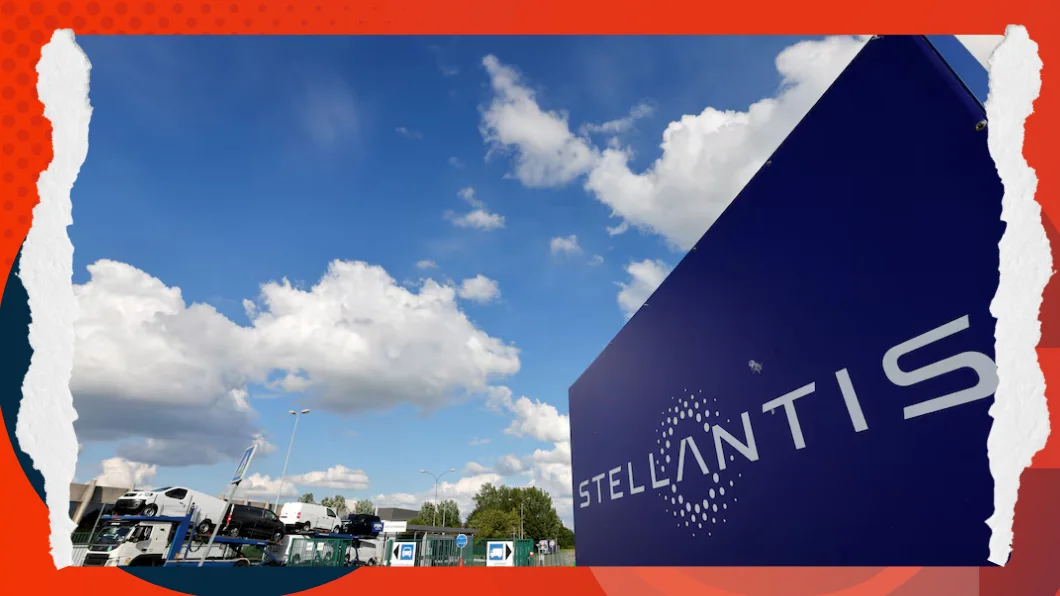
Stellantis has joined forces with Uber, NVIDIA, and Foxconn to develop Level 4 autonomous vehicles that could reshape how cities move people. The alliance, announced in late October 2025, positions Stellantis not just as an automaker but as a technology supplier for the next phase of shared mobility.
Under the plan, Uber will deploy about 5000 robotaxis beginning in 2028 across select global markets. Each vehicle will use Stellantis’ new AV-ready electric platforms equipped with NVIDIA’s DRIVE Hyperion architecture, designed for full self-driving capability under controlled conditions.
While the initial rollout will focus on North America and Europe, the Middle East has the infrastructure and policy frameworks that could make it one of the first regions to adopt such fleets at scale.
Inside the Partnership and the Technology
The collaboration divides responsibilities across four global heavyweights. Stellantis will design and manufacture the vehicles using its STLA Medium and K0 platforms, Foxconn will handle electronics and sensors, NVIDIA will supply AI hardware and perception software, and Uber will operate the fleets, integrating live data from riders and cities.

Carlos Tavares described autonomous fleets as “the next chapter of shared mobility,” emphasising that software and services will define future growth more than vehicle sales. The partnership leverages NVIDIA’s DRIVE Hyperion 9 platform, which merges onboard AI with cloud-based fleet management, allowing each car to learn from collective driving data and over-the-air updates.
The deal deepens Uber’s transition from ride-hailing app to mobility-as-a-service platform, outsourcing vehicle production while retaining user data, route analytics, and payment systems. For Stellantis, it marks entry into a higher-margin, software-driven ecosystem that extends far beyond manufacturing.
The Gulf’s Readiness for Robotaxis
If there’s anywhere outside Silicon Valley ready for a driverless future, it’s the Gulf. The region has spent the past decade building the foundations for autonomous mobility, from regulation to infrastructure, long before most countries began public trials.
In Dubai, the Autonomous Transportation Strategy targets 25 percent of all trips to be driverless by 2030, supported by pilot zones for electric and autonomous vehicles under the Roads and Transport Authority (RTA)’s framework (Dubai RTA). The city has already approved limited robotaxi testing with Cruise, the General Motors–backed self-driving company, set to begin commercial operations in 2026.
In Saudi Arabia, NEOM is integrating fully autonomous mobility corridors across The Line and Oxagon, where all transport systems will be AI-managed and emission-free. The projects are not experiments; they are central to national strategies for digital urban design under Vision 2030.
Meanwhile, Abu Dhabi’s Bayanat, a geospatial and AI firm partly owned by G42, has tested autonomous shuttles and delivery vehicles since 2023, laying groundwork for regulatory frameworks that can support private sector deployment.
Together, these initiatives give the Gulf a distinct edge:
- Policy clarity that defines how and where autonomous vehicles can operate.
- 5G and edge-computing coverage that ensures real-time data transfer between vehicles and control centres.
- Public awareness campaigns, such as Dubai’s Smart Mobility Challenge, which encourage citizens to embrace AI-driven transport.
For Uber and Stellantis, this ecosystem offers an ideal testbed. The hardware and software exist, the regulation is evolving, and public acceptance has been steadily built through years of smart mobility programmes.
Economic and Urban Implications
Robotaxis could reshape Gulf urban economies, changing how transport and city space are valued. In a region where private car ownership still dominates, autonomous fleets introduce a model of transport built on shared access, electrification, and data-driven logistics.
For governments, robotaxis are not just about convenience but about urban planning. A city with fewer private vehicles can reallocate parking land to housing, parks, or retail zones.
Platforms like Uber and Careem already serve over 30 million users across the Middle East. Adding autonomous vehicles could help these platforms scale without the constraints of driver supply, cutting operational costs and extending coverage to lower-demand areas.
Each fleet also generates valuable movement data; origin-destination flows, demand peaks, and energy use, that can feed into AI-driven city planning. Dubai and Riyadh already use real-time mobility data from ride-hailing platforms to adjust bus routes and parking allocations. Robotaxi data could sharpen that precision, turning transport management into predictive planning.
The environmental impact is equally significant. Robotaxis will likely be electric, supporting regional net-zero goals such as UAE Net Zero 2050 and Saudi Green Initiative 2060. Still, challenges remain: heat will test batteries, and AI systems must adapt to local driving behaviours and urban layouts.
Each layer of autonomy, electrification, and analytics moves the Gulf closer to a transport model where cities, think and cars act, intelligently.
Policy and Future Outlook
The Stellantis–Uber partnership could push Gulf policymakers to move from vision to detailed regulation. Current frameworks in the UAE and Saudi Arabia define pilot permissions but stop short of addressing large-scale deployment, insurance models, or liability in collisions.
The Dubai RTA has outlined plans to develop a certification framework for commercial driverless vehicles by 2026, modelled partly on U.S. NHTSA standards. Meanwhile, Saudi Arabia’s Transport General Authority is drafting the region’s first guidelines for data handling, safety validation, and autonomous testing corridors.
For investors, this evolution opens new possibilities. Funds such as Saudi Arabia’s Public Investment Fund (PIF) and Mubadala Investment Company, already major backers of Lucid Motors and Wayve, could expand into joint ventures for local assembly, maintenance hubs, and AI infrastructure.
If Uber’s global rollout meets expectations, the Gulf could become its first non-Western robotaxi market. Dubai and Riyadh remain among Uber’s busiest and most strategic cities, with governments actively pursuing AI integration in public transport.
The infrastructure is nearly ready. The appetite for innovation is proven. And as Stellantis, Uber, and NVIDIA shift from manufacturing vehicles to manufacturing intelligence, the Middle East may not just adopt the robotaxi model, it could define what autonomous mobility looks like when built for entire cities, not just for roads.