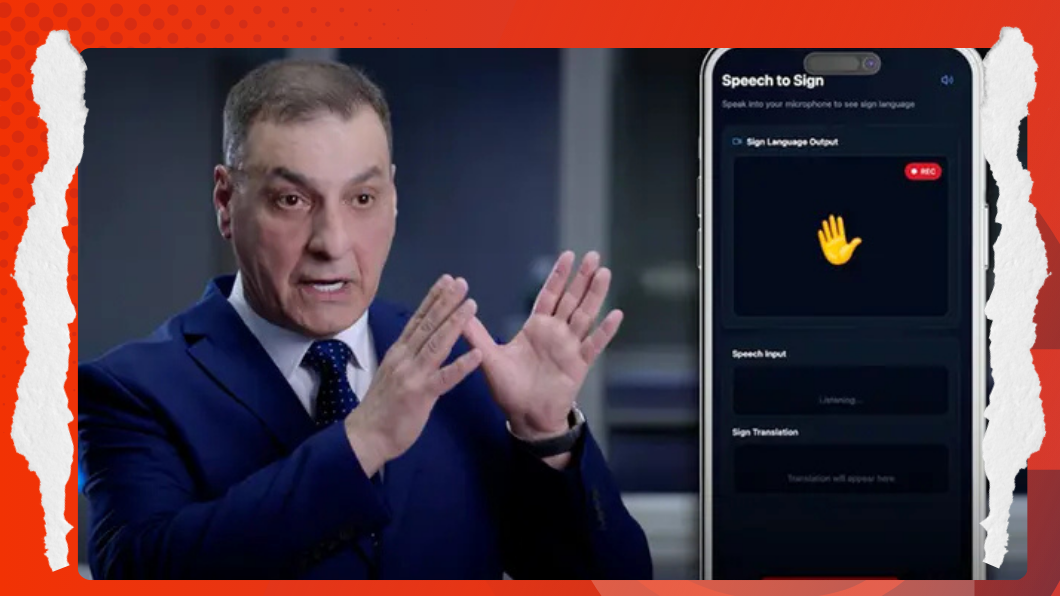
Abu Dhabi University has secured a patent for HearMe, an AI-powered multilingual sign language translation app built by Dr Modafar Ati and alumna Reem Al Bostami. The university says the app translates signed gestures into written words in real time and turns typed text into animated sign language. It also says the system supports more than one sign system, including American Sign Language and French Sign Language, with a focus on use in classrooms, training programmes, and workplaces.
This matters because sign language remains one of the hardest areas in accessibility tech. Google has said sign language communication depends on hand movements, body posture, facial expression, speed, eye contact, and more. Google also notes that the world uses many sign languages, not one shared system. That makes accurate translation much harder than simple speech transcription or captioning.
HearMe focuses on real conversations
HearMe stands out because it aims to support two-way communication. One side of the exchange starts with signed gestures and ends as text. The other starts with typed text and ends as animated sign language. That setup targets actual back-and-forth conversation instead of one-way access only. In practical terms, that gives the app a clearer purpose in education and work settings where people need to ask, answer, explain, and respond on the spot.
The multilingual angle also gives the project weight. Sign languages do not follow one global standard. A tool that works across different sign systems tackles a real barrier for students, workers, and institutions that serve people across borders. That matches the broader push in tech to build tools that work across languages and settings, not just within a single market.
Sign language AI is hard to build well
Many AI products handle text, voice, and images with growing confidence. Sign language asks for more. A strong system has to read hands, facial expression, motion, and body pose together. Google described its own sign language work in those exact terms when it explained how machine learning models must go beyond hands alone. That is why this field has moved more slowly than speech recognition and live captioning.
That challenge also explains why HearMe deserves attention. Abu Dhabi University did not announce a generic chatbot or another caption layer. It announced a patented app aimed at a specific accessibility problem that large tech companies still treat as a difficult research area. In a market full of broad AI claims, that kind of narrow and practical focus feels more grounded.
WHO shows the size of the need
The need for better hearing and communication tools is already large. The World Health Organization says more than 430 million people worldwide require rehabilitation for disabling hearing loss today. It adds that more than 700 million people are likely to have disabling hearing loss by 2050. WHO also says unaddressed hearing loss can limit communication, education, employment, and social participation. Those figures explain why practical accessibility tools deserve serious product attention.
Abu Dhabi University says HearMe aims to help people with hearing impairments take part more fully in higher education and professional training. That gives the project a useful starting point. Education and work are the settings where communication barriers often carry direct costs for progress, confidence, and access. A tool that reduces friction there serves a clear public need.
HearMe now needs a public path
A patent gives HearMe credibility, but public impact will come from execution. Real success now depends on how well the app performs in live settings, how it handles different signing styles, and how closely the team works with Deaf users and educators during testing. Google has made the same point in practice through its own work by partnering with Deaf communities and language experts. In accessibility tech, strong collaboration matters as much as model quality.
The Abu Dhabi announcement did not set out a public launch timeline, pricing plan, or broad rollout roadmap. That leaves open questions about distribution and scale. Even so, the patent gives Techsoma readers something more concrete than the usual AI noise. It shows a university team building a focused tool for a real communication need at a time when the industry keeps looking for useful AI beyond chat and image generation.
Tech does not need more vague promises. It needs more products that solve clear problems for real people. HearMe earns attention because it follows that path. If Abu Dhabi University turns this patent into a reliable public tool, it will add something useful to an area of AI that deserves far more care and far more investment.