
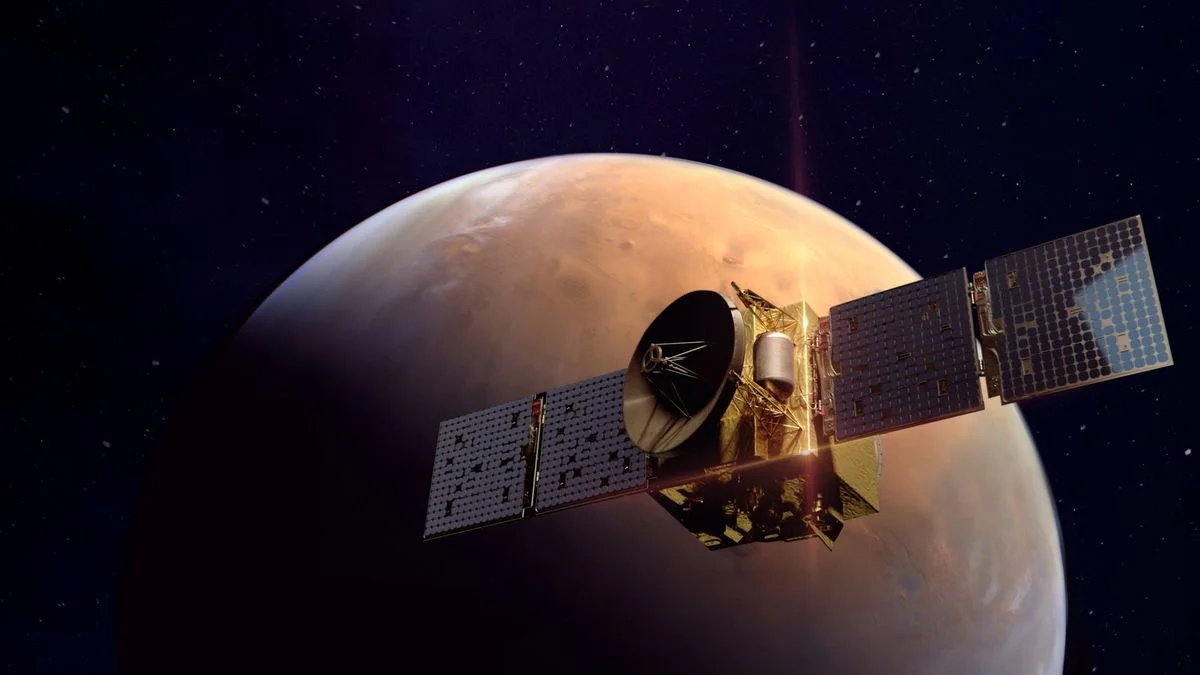
When the UAE launched its Hope Probe in July 2020, the goal was modest by space exploration standards: gather one terabyte of data on Mars. Five years later, the probe has delivered more than ten times that amount, and the UAE Space Agency has announced it’s not done yet, extending the Emirates Mars Mission by three years to 2028.
A Mission That Outgrew Its Own Ambitions
The announcement was made by Dr Ahmad Belhoul Al Falasi, Chairman of the UAE Space Agency, who framed the extension as a natural response to a spacecraft that simply kept performing. The Hope Probe entered Martian orbit on February 9, 2021, making the UAE only the fifth entity in history (after the US, Russia, India, and China) to reach Mars. What began as a two-year primary mission has since become one of the most comprehensive atmospheric observatories currently operating around the planet.
The data has been shared with the general scientific community. All 10-plus terabytes have been released publicly across 16 data batches, freely accessible to the global scientific community. That openness has helped generate 35 peer-reviewed scientific papers and contributions to hundreds of international conferences. The mission effectively transformed the UAE from a consumer of space data into a producer of it.
What the Probe Has Actually Found
Science has kept pace with the ambition. The Hope Probe has built an unprecedented picture of Martian daily and seasonal weather cycles, tracking every dust storm recorded during its time in orbit. It has captured the highest-resolution images ever taken of Deimos, Mars’ smaller and less-studied moon, from roughly 100 kilometres away, revealing previously unseen regions that are reshaping our understanding of the moon’s origins and composition.
Perhaps most unexpectedly, the probe identified new types of aurora on Mars and, in October 2025, observed the interstellar comet 3I/ATLAS, only the third known object from outside our solar system to pass through the neighbourhood. That’s a long way from studying seasonal weather patterns.
The three-year extension will focus on the relationship between Mars’ lower and upper atmospheres, which scientists say has proven far more complex than initial models suggested. Each additional Martian year of data, mission scientists have said, could unlock centuries of research.
Beyond the Red Planet
The mission’s significance reaches well beyond what the probe has photographed. STEM enrolment in the UAE has risen 31% in four years, a trend officials directly attribute to the programme’s visibility and ambition. Components and engineering knowledge developed for the Hope Probe are already being repurposed for the UAE’s next venture, the Emirates Mission to the Asteroid Belt, currently scheduled for launch in 2028.
That parallel timeline is deliberate. The Mars mission was never just science. It was a proof of concept for what the UAE could build, attract, and inspire, and by almost every measure, it has delivered.