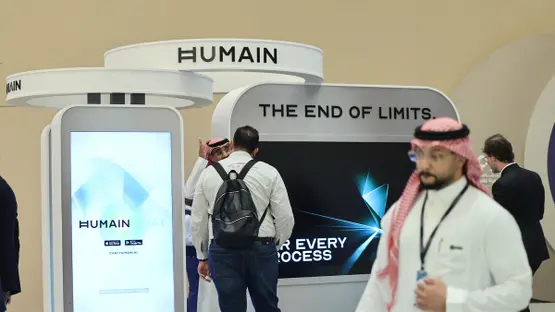
Saudi Arabia’s push to position itself at the centre of the global artificial intelligence economy has taken a decisive step forward, with Humain announcing a strategic partnership with US-based AI firm Turing to build and scale enterprise AI agents worldwide.
The agreement, unveiled at the FII Priority summit in Miami, centres on the creation of what both companies describe as the world’s first enterprise-grade AI agent marketplace, hosted on Humain’s platform, Humain One.
Building the marketplace for the agentic era
At the core of the partnership is a simple but ambitious idea: move enterprises beyond traditional software into systems where AI agents actively execute work.
The Humain One platform is designed to allow organisations to discover, deploy, and scale AI agents across key business functions, including finance, human resources, legal, procurement, and operations. These agents are not passive tools. They are autonomous systems capable of carrying out workflows, making decisions, and continuously improving through learning and integration with enterprise data.
For Humain, this reflects a broader vision of an “AI operating system” for businesses, where agents replace standalone applications as the primary interface for productivity.
Combining infrastructure with intelligence
The partnership splits responsibilities along clear lines.
Humain, backed by Saudi Arabia’s Public Investment Fund, brings its full-stack AI capabilities, including infrastructure, cloud platforms, and model orchestration.
Turing contributes its expertise in model evaluation, fine-tuning, reasoning systems, and enterprise deployment, areas critical to turning experimental AI into production-grade systems.
Together, the two companies aim to accelerate the development of reliable, enterprise-ready AI agents rather than experimental prototypes. This combination is deliberate. The current bottleneck in AI is no longer just model capability, but deployment at scale inside real organisations.
A new commercial layer for AI
One of the more significant elements of the initiative is the marketplace itself.
The platform will allow third-party developers to build, publish, and monetise AI agents, effectively creating a new economic layer around enterprise AI.
This shifts AI from a closed, vendor-controlled model to a more open ecosystem, where specialised agents can be developed for specific industries, workflows, or regulatory environments. In practical terms, it mirrors the evolution of app stores, but for autonomous software systems capable of executing business processes.
From SaaS to agent-driven enterprises
The partnership is rooted in a broader shift already underway in enterprise technology.
For decades, software has functioned as a support layer, helping humans complete tasks. The agent model reverses that dynamic, with AI systems taking on execution while humans supervise, guide, and intervene where necessary.
Humain’s leadership frames this as the next phase after SaaS, where productivity gains come not from better tools, but from delegating work itself to intelligent systems.
The implication is significant. If successful, agent-based systems could redefine how companies structure teams, workflows, and decision-making processes.
Saudi Arabia’s bid to export AI, not just adopt it
The deal also carries geopolitical weight. Humain was established as part of Saudi Arabia’s broader strategy to diversify its economy and build global leadership in AI infrastructure and platforms.
By partnering with Turing and positioning it as the first US-based customer of Humain One, the company is signalling a shift in narrative: from importing technology to exporting it. This aligns with the Kingdom’s wider investments in data centres, AI chips, and global partnerships aimed at turning it into a hub for advanced computing.
A global test for enterprise AI adoption
Enterprise AI has long been constrained by integration challenges, regulatory concerns, and the gap between prototype and production. The marketplace model attempts to address all three by standardising deployment, enabling distribution, and creating incentives for developers.
If it works, it could accelerate the adoption of AI agents across industries globally.
If it fails, it will highlight the persistent difficulty of turning AI capability into real economic productivity.
Either way, the partnership marks a clear turning point.