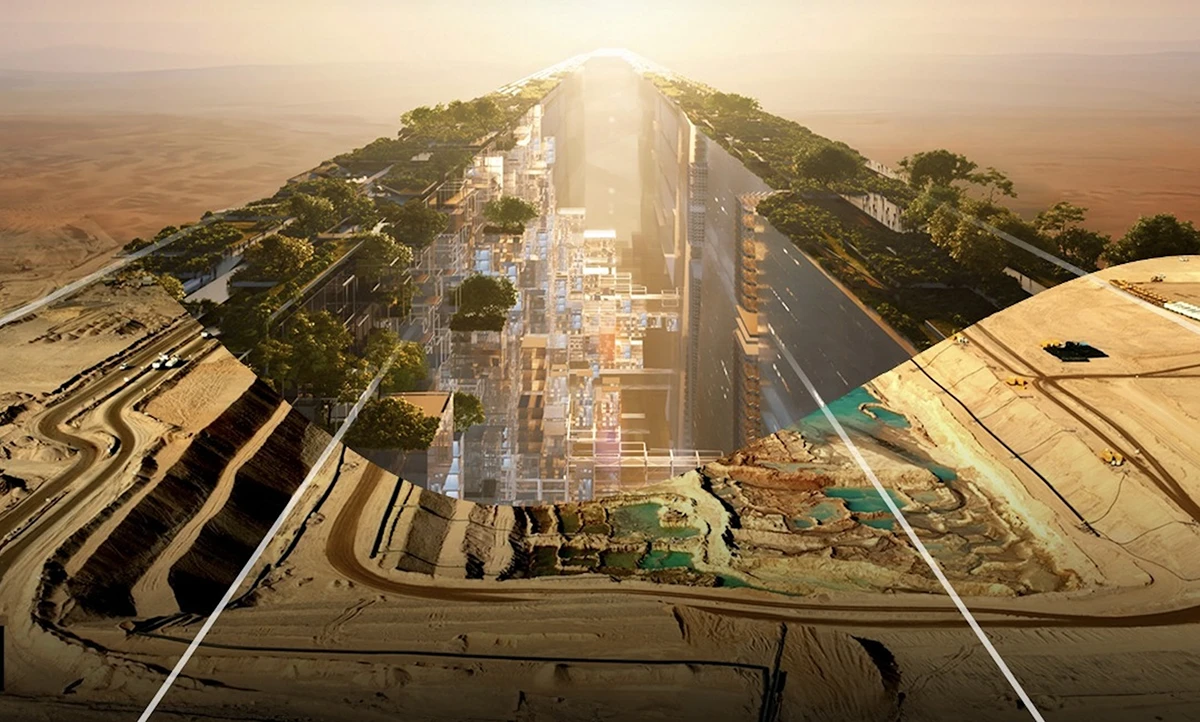
When NEOM’s The Line was unveiled in 2021, it looked like science fiction rendered in glass and ambition, a 170-kilometre mirrored city stretching through Saudi Arabia’s desert, home to nine million people and powered entirely by renewable energy. Four years on, the vision has been quietly, but significantly, redrawn.
A Megacity Put on Pause
Reports emerging in late 2024 confirmed what project insiders had been whispering for months: The Line’s construction had been scaled back dramatically. The initial phase, originally slated to house around 1.5 million residents by 2030, was revised down to a stretch of just 2.4 kilometres, barely a sliver of the original blueprint. Cost overruns, engineering complexity, and a cooling global appetite for speculative gigaprojects all played their part.
For a project that was meant to define the post-oil Saudi economy, the retreat was a significant one. But Riyadh, it turns out, had a contingency plan.
AI Infrastructure Moves to the Front of the Queue
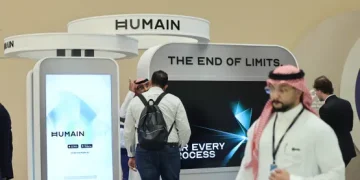
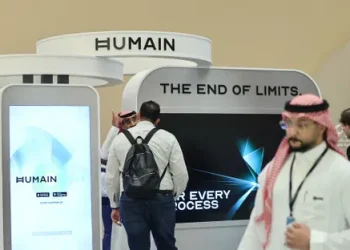
Saudi Arabia has pivoted with striking speed toward positioning itself as a major global hub for artificial intelligence infrastructure. The kingdom’s $925 billion Public Investment Fund (PIF) has been directing capital into AI and data centre development at scale, and the desert land originally earmarked for The Line’s sprawling footprint now looks better suited to server farms than skyscrapers.
In early 2025, the Saudi government announced a series of agreements with major US technology firms as part of a broader push under its updated Vision 2030 framework. The logic is straightforward: data centres require vast land, reliable power, and political stability. Saudi Arabia, with its surplus of cheap renewable energy from solar projects like NEOM’s own power infrastructure, offers all three.
The Desert as a Digital Backbone
The geographic and climatic conditions that made The Line so expensive to build for human habitation actually work in favour of data centre development. The region’s intense sunlight supports large-scale solar generation. Sparse population density means land acquisition is uncontested. And the geopolitical positioning of Saudi Arabia (between European, Asian, and African data corridors) makes it an attractive neutral node for global cloud routing.
NEOM itself has not abandoned all ambitions. The broader project still encompasses Sindalah, the island luxury resort, and Trojena, the mountain ski development. But the industrial and utility zones within the wider NEOM territory are being reconfigured to accommodate AI compute infrastructure rather than residential towers.
What This Means for Vision 2030
The shift carries a deeper strategic logic. Saudi Arabia was never going to diversify its economy by building a city alone because it needed industries to populate it. AI infrastructure inverts that equation: it generates revenue, attracts technical talent, and builds digital sovereign capacity without requiring millions of residents to show up first.
The kingdom has also been investing in domestic AI capability through the Saudi Data and AI Authority (SDAIA) and its national AI strategy, aiming to capture value not just as a host for foreign compute but as a developer of Arabic-language models and regional AI applications.
Pragmatism Over Spectacle
What the rethinking of The Line ultimately signals is a maturation in how Saudi Arabia approaches its transformation. The original pitch was heavy on spectacle: a city with no cars, no streets, cognitive AI managing everything. The revised direction is less photogenic but considerably more bankable.
Data centres don’t make for dramatic renderings. But they generate cash, scale incrementally, and align with where global capital is actually flowing. For a country that still needs to prove its post-oil model can work, that trade-off may be exactly the right one to make.
The Line may yet be built, in some form, at some scale. But for now, Saudi Arabia’s most consequential infrastructure investment is invisible, humming quietly in the heat, and running at the speed of light.