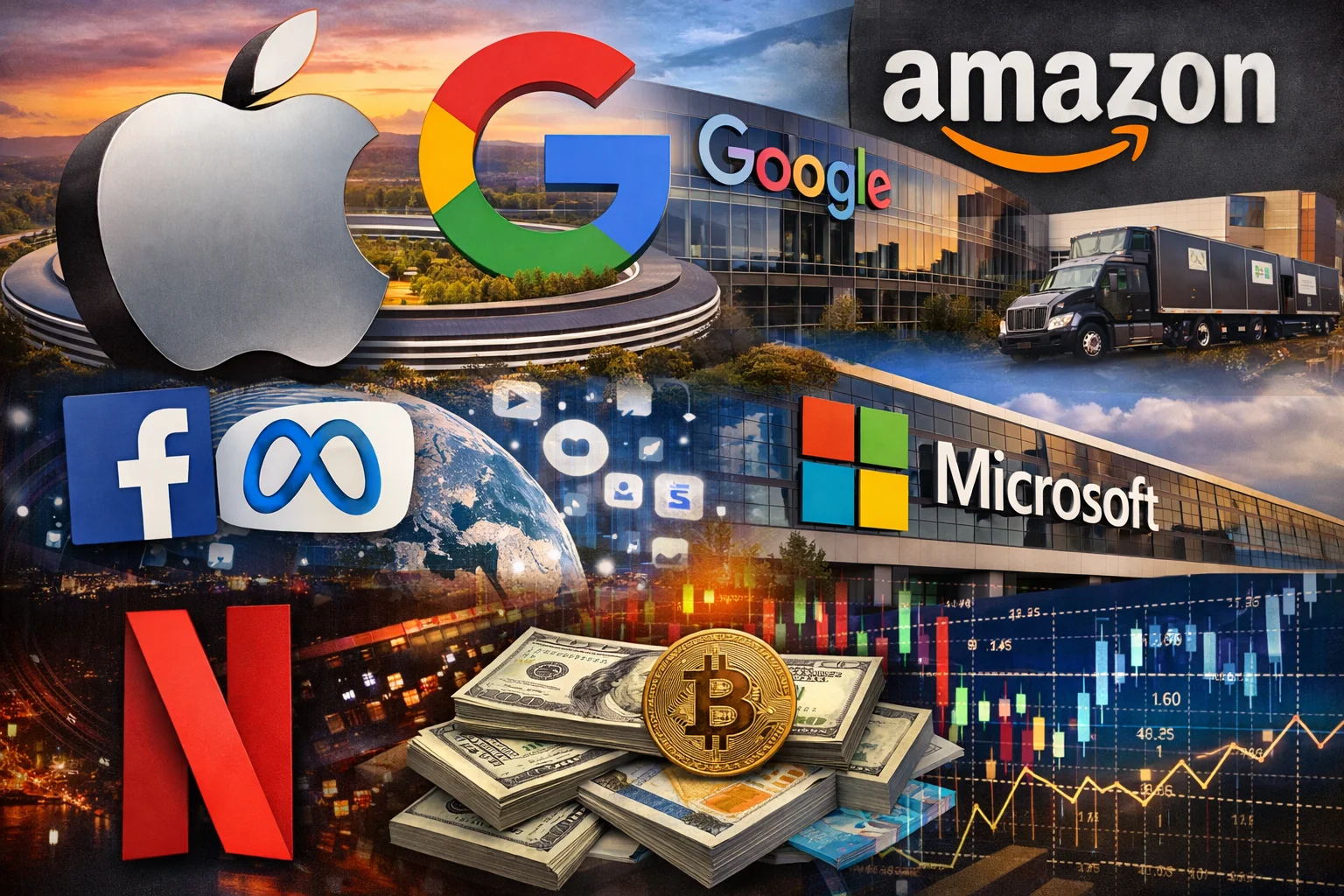
For two decades, Big Tech operated on one principle: grow at all costs. Acquire users, expand markets, disrupt industries, worry about profits later. Facebook wanted everyone on social media. Google wanted to organise all the world’s information. Amazon wanted to sell everything to everyone.
That era is over.
Today’s Big Tech operates under a different mandate: control. Control over markets, competitors, information access, and how we shop, communicate, and work. This shift from growth to control represents one of the most significant transformations in modern capitalism.
The End of Growth
The numbers are clear. Meta’s user growth has stalled in developed markets. Google dominates over 90% of global search, with nowhere left to expand. Amazon controls nearly 40% of US e-commerce. Apple’s iPhone market share has plateaued.
When growth slows, businesses face a choice: accept lower returns or extract more value from existing positions. Big Tech chose extraction. But extraction requires control over suppliers, competitors, users, and entire ecosystems.
The shift became visible around 2018-2020. Facebook stopped trying to convince everyone to join and started maximising revenue per user. Google tightened its grip on search results, favouring its own properties. Amazon began copying successful third-party products. Apple started taking larger cuts from app developers while limiting their alternatives.
How Control Works
Big Tech’s control operates through interconnected mechanisms that make competition nearly impossible.
Platform power is the foundation. Apple decides which apps iPhone users can install and takes up to 30% of all revenue. Google determines which websites get traffic through search rankings. Amazon controls which products appear first in search results. Meta decides what content billions see in their feeds. Platform owners set the rules, change them at will, and compete directly with those dependent on their platforms.
Ecosystem lock-in has become sophisticated. Your iPhone works seamlessly with your MacBook, iPad, Apple Watch, and AirPods. Moving to Android means losing that integration. Your Google account connects Gmail, Drive, Photos, Calendar, and YouTube. Switching means fragmenting your digital life. The more services you use, the higher the switching costs, and the more control the company has.
Data asymmetry creates insurmountable advantages. Amazon knows what products sell, at what prices, to which demographics. Google knows what people search for and click on. Meta knows what content drives engagement. This information means Big Tech can enter any market with better data than competitors who’ve operated there for years.
Network effects at a massive scale become weapons. Facebook isn’t valuable because it’s well-designed; it’s valuable because everyone is there. Once network effects reach critical mass, they create natural monopolies nearly impossible to disrupt.
What Control Looks Like
Google increasingly answers questions directly on search results pages, keeping users within Google’s ecosystem and reducing traffic to websites that created the information. For businesses, this means you must play by Google’s rules or become invisible. Want customers to find you? You increasingly need to pay Google for ads, even for searches of your own brand name.
Amazon operates as both a platform and a competitor. Amazon provides infrastructure for third-party sellers, collects data on what sells, and then launches competing products. Sellers face an impossible choice: accept Amazon’s terms and risk being undercut, or skip the platform and lose access to a massive customer reach.
Apple’s App Store demonstrates control through gatekeeping. Apple decides which apps users can install, takes 15-30% of digital revenue, and prohibits apps from directing users to alternative payment methods. When Epic Games tried to circumvent Apple’s payment system, Apple removed Fortnite entirely.
Meta controls attention and information flow. The algorithm decides what you see, what goes viral, and what disappears. Meta has systematically copied or acquired potential competitors: Instagram, WhatsApp, and attempted TikTok features. When you control how billions communicate, you control which communication platforms exist.
The Economic Consequences
Innovation suffers. When Big Tech can acquire or copy any successful startup, venture capital flows only to ideas that might get acquired rather than ideas that might compete. The “kill zone” around major platforms (areas where startups struggle to raise funding) continues expanding.
Small businesses face extraction. Companies dependent on Big Tech platforms see fees rising while terms deteriorate. Amazon sellers pay more in fees. App developers surrender larger revenue shares. Small retailers pay more for Google ads. Meanwhile, these platforms become essential infrastructure.
Workers and creators lose bargaining power. YouTube creators have no meaningful alternative if YouTube changes monetisation rules. Uber drivers can’t negotiate when the platform controls pricing. When you control the platforms where work happens, you control the terms.
Consumers pay for choice and autonomy. Markets that look competitive often involve the same underlying infrastructure controlled by Big Tech. More insidiously, their algorithms decide what you see, their interfaces shape how you think about problems, and their ecosystems determine which solutions are available.
Beyond Economics
When a few companies control essential digital infrastructure, they gain power over information, speech, privacy, and democracy itself.
Information gatekeeping: Google’s search rankings determine which information people find credible. Facebook’s algorithm shapes what news billions see. YouTube’s recommendations guide what people watch and believe. These companies claim neutrality, but their algorithms make millions of editorial decisions daily that are optimised for engagement rather than accuracy.
Privacy becomes impossible. When a few companies mediate most digital interactions, they see everything: your searches, purchases, communications, movements, relationships, interests, and behaviours. Opting out isn’t possible when these services are essential for modern life.
Democratic discourse happens on privately controlled platforms with opaque rules. Meta, Google, and X decide which political speech is allowed, which accounts get amplified, and what content gets suppressed. We’ve privatised the public square, then expressed surprise when private companies act in their private interests.
What We Can Do
Individual actions matter less when facing structural power, but they’re not meaningless:
Support alternatives when they exist. Use privacy-focused services, shop at independent retailers when possible, and choose open platforms over closed ecosystems.
Understand the trade-offs. Convenience comes at a cost. Free services aren’t free because you’re paying with data and attention.
Demand better from regulators. Support politicians who take Big Tech power seriously. Contact representatives about specific issues. Regulatory capture works when the public isn’t paying attention.
Push for interoperability and data portability. You should be able to switch platforms without losing your social connections or digital life. Regulations requiring interoperability could reduce switching costs.
The Larger Question
Ultimately, this shift forces us to confront a fundamental question: who should govern the digital infrastructure of modern life?
Should private companies, accountable only to shareholders, make decisions affecting billions? Should governments regulate platforms like utilities? Should we develop new governance models such as digital cooperatives, public trusts, or hybrid approaches?
For two decades, we let Big Tech self-govern on the assumption that growth and innovation would benefit everyone. That experiment has ended. Growth has stalled, innovation has slowed, and control has concentrated.
The platforms won’t reform themselves. The market won’t correct itself. The control won’t diminish through waiting. If we want a different digital future, we’ll have to build it deliberately, probably against fierce resistance from companies that benefit from the status quo.
The question isn’t whether Big Tech is too powerful because that debate is over. The question is whether we have the political will to do anything about it before control becomes so entrenched that alternatives become unimaginable.
That’s the real shift: from growth to control, and from control to permanence. Unless we act soon, Big Tech’s dominance won’t just be a phase of capitalism. It will be the permanent architecture of digital life.