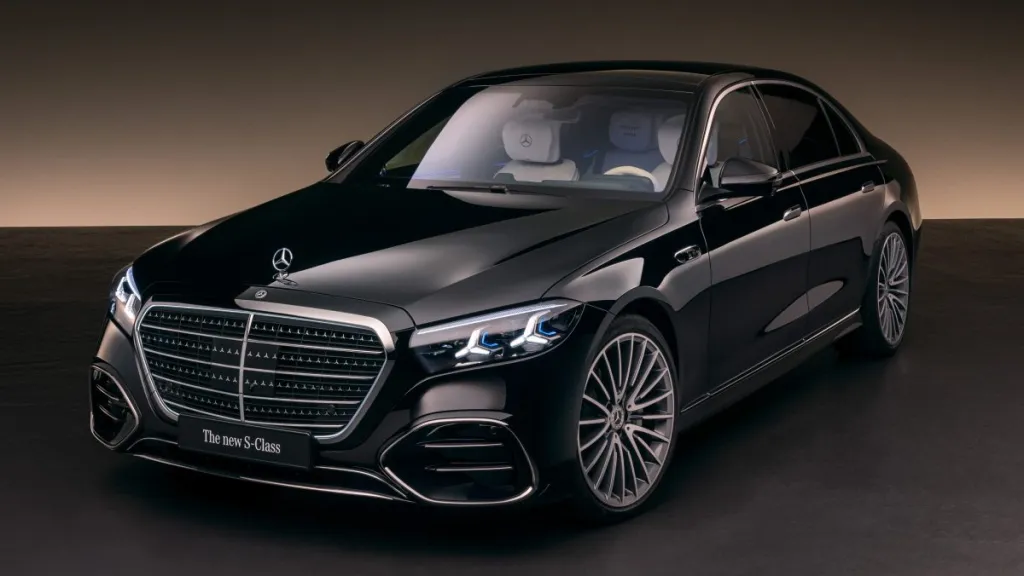
Mercedes-Benz has unveiled its next-generation S-Class, and the changes run far deeper than the usual luxury sedan refresh. The new S-Class is built on NVIDIA DRIVE Hyperion with full-stack NVIDIA DRIVE AV software, featuring an L4-ready architecture that combines end-to-end AI with parallel classical driving stacks. This isn’t incremental improvement; it’s Mercedes positioning its flagship as a potential autonomous vehicle platform.
The announcement represents a significant strategic shift. Mercedes-Benz is collaborating with NVIDIA and Uber to create a robotaxi ecosystem based on the new S-Class, with plans for the mobility provider Lumo to operate shuttles initially in Abu Dhabi. The company is essentially building a car that can function both as a chauffeured luxury vehicle and as a driverless taxi service.
Computing Power Meets Craftsmanship
The new S-Class features MB.OS running on a water-cooled supercomputer that underpins all interior electronics, handles over-the-air updates, runs the MBUX infotainment system, and governs automated parking and driver assistance systems. Yes, your luxury sedan now needs liquid cooling for its onboard computer.
The infotainment setup reflects this computational ambition. Mercedes calls its new setup the “Superscreen,” consisting of a 12.3-inch digital instrument cluster, a 14.3-inch central touchscreen, and a 12.3-inch passenger display, with two additional 13.1-inch displays mounted to the front seatbacks for rear passengers.
AI integration extends throughout the cabin experience. ChatGPT, Microsoft Bing, and Google Gemini provide extra functionality for the voice-activated “Hey Mercedes” commands, along with a virtual assistant with two avatar options. The system also offers native apps like Disney+ and YouTube directly through MBUX, acknowledging that passengers in an autonomous vehicle will need entertainment options.
The Comfort Tech Gets Smarter
Beyond autonomous capabilities, Mercedes has focused on what it calls AI-driven comfort. The advanced AI comfort system learns driver and passenger preferences over time, automatically adjusting seat position, climate control, ambient lighting, and even driving behaviour, recognising different users and personalising the cabin environment accordingly.
Perhaps most intriguing is the suspension’s cloud connectivity. The new S-Class features cloud-based damper regulation as part of the Airmatic air suspension system, which can proactively detect road irregularities ahead and store data on speed bumps for 14 days using cloud computing, allowing other S-Classes to pre-prepare. Your car now learns from every other S-Class on the road.
A Flat-Plane V8 in a Luxury Sedan
The powertrain lineup includes an unexpected highlight. The S580 is powered by an all-new 4.0-litre V8 engine featuring a flat-plane crankshaft, producing 530 horsepower and 553 pound-feet of torque, boosted by a mild-hybrid system with an integrated starter-generator that adds an extra 23 horsepower.
Flat-plane cranks are typically reserved for high-revving sports cars like the Ferrari 488 or Ford Mustang Shelby GT350. Their use in a luxury sedan prioritising refinement is unusual, though Mercedes claims benefits include reduced rotating mass and better response.
The lineup also includes turbocharged inline-six engines in the S450 and S500 variants, a reworked inline-six diesel, and a plug-in hybrid pairing the inline-six with an electric motor for a combined 577 horsepower.
The Autonomous Reality Check
The L4-ready architecture is designed to support future robotaxi operations with the NVIDIA Halos safety system and end-to-end AI and classical driving stacks running in parallel to ensure reliable operation. But “L4-ready” doesn’t mean L4-capable at launch, particularly in markets with restrictive autonomous driving regulations.
In Germany, the existing Drive Pilot system now operates at speeds up to 95 km/h on highways, but in the United States, it remains limited to 60 km/h pending regulatory approval. The full autonomous capabilities Mercedes is building into this platform may take years to activate in most markets, if they’re permitted at all.
The robotaxi partnerships underscore where Mercedes sees the real opportunity. Mercedes-Benz announced another L4 project in cooperation with Momenta to develop a robotaxi experience based on the new S-Class. The company is hedging its bets, building a car that can serve traditional luxury buyers while positioning itself for a potential autonomous future.
For now, the 2027 S-Class remains a traditionally driven luxury sedan with extraordinary computational capabilities and advanced driver assistance.