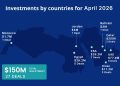
Egypt has once again emerged as Africa’s leading destination for private foreign investment, holding the top position on the continent for the fifth consecutive year. The milestone reinforces the country’s growing pull on global capital at a time when investment flows remain uneven across emerging markets.
Five Years at the Summit
Government figures confirm that Egypt attracted more private foreign investment than any other African economy over the past year. The streak reflects sustained inflows rather than a one-off surge, placing Egypt ahead of traditional competitors such as South Africa, Nigeria and Morocco.
Private investment growth accelerated sharply during the most recent fiscal year, driven by renewed confidence from international investors and regional capital allocators.
Reform, Not Hype, Behind the Numbers
Egypt’s performance has been closely tied to a series of fiscal and structural reforms aimed at stabilising the economy and reducing friction for investors. Authorities have prioritised currency market adjustments, tax simplification and clearer investment rules.
These measures have helped improve foreign exchange liquidity and restore predictability, two factors that previously deterred long-term private capital.
Where the Money Is Going
Investment has concentrated in capital-intensive sectors with long horizons. Energy, transport infrastructure, manufacturing and logistics have attracted the bulk of new inflows. Large-scale projects, particularly those linked to energy and trade corridors, have played a significant role in lifting overall figures.
At the same time, private investment outside megaprojects has expanded, suggesting broader participation rather than dependence on a narrow set of deals.
Standing Out in a Tough Global Climate
Egypt’s investment gains stand out against a global backdrop of cautious capital movement. Worldwide foreign investment has softened in many regions due to higher interest rates, geopolitical risk and slower growth in developed economies.
Within Africa, flows remain concentrated in a small number of countries. Egypt’s ability to consistently capture a large share reflects scale, market size and policy direction rather than cyclical luck.
What Comes Next
Maintaining the lead depends on execution because investors are watching closely to see whether reforms deepen, inflation remains contained, and currency stability holds. The shift from crisis management to sustained growth will determine whether Egypt converts headline inflows into long-term productivity gains.
For now, Egypt’s fifth straight year at the top signals a clear message: private capital sees the country as Africa’s most reliable large-scale investment destination.